Distribution Planning for High DER Penetration: Hosting Capacity, Non-Wires Alternatives, and Grid Modernization Investment
Published: June 2026 Technical Level: Advanced Category: Protection Systems
Abstract
Distribution system planning methodology is undergoing a structural transformation driven by two converging forces: the rapid growth of customer-sited distributed energy resources that inject power into distribution feeders rather than only consuming it, and the deployment of distribution automation equipment that creates new operational flexibility for managing the resulting bidirectional power flows. Traditional peak-load-driven planning (size conductors, transformers, and substation capacity for the highest anticipated load demand) is insufficient for systems where the binding constraints are overvoltage during minimum-load maximum-generation conditions, thermal overloads during export events, and protection coordination failures during DER fault current contribution. This paper develops the modern distribution planning methodology for high DER penetration: probabilistic hosting capacity analysis, time-series simulation for constraint identification, non-wires alternatives as cost-effective substitutes for traditional infrastructure upgrades, and the integrated investment planning framework that evaluates traditional and non-traditional solutions on a level economic footing. The regulatory context of FERC Order 2023 and the utility planning disclosure requirements it creates are addressed throughout.
1. Introduction
The distribution planning engineer's toolkit has traditionally consisted of peak load forecasting, thermal ratings analysis, and voltage drop calculation. The planning output was a capital investment program: new substation capacity, conductor replacements, voltage regulator additions, and capacitor bank upgrades sized to serve the forecasted peak load with adequate voltage and thermal margins. This toolkit and its associated planning process were developed for a system structure, radial feeders serving passive loads, that is becoming increasingly inadequate as the DER penetration on many distribution systems reaches 30 to 60 percent of peak load.
The inadequacy manifests in two ways. First, the traditional planning tools identify constraints correctly for the peak load condition but miss constraints that occur under minimum-load maximum-generation conditions: the afternoon valley on a spring Sunday when rooftop solar is at its peak but air conditioning loads are off. Second, the traditional planning solution set, build more capacity, is often not the most economical response to DER-driven constraints, because those constraints are temporal: they occur for a limited number of hours per year when the generation-load coincidence is most extreme. A conductor thermal overload that occurs for 50 hours per year out of 8,760 hours may be more economically addressed by a battery storage system that absorbs the excess generation during those 50 hours than by a conductor replacement that provides excess thermal capacity for 8,710 hours per year when the overload does not occur.
2. Hosting Capacity Analysis
2.1 Methodology
The hosting capacity of a distribution feeder is defined as the maximum DER capacity that can be accommodated without violating any of the applicable performance criteria (voltage, thermal, protection, power quality) under any combination of load and generation conditions within the expected operating range. The EPRI hosting capacity methodology (Technical Report 3002004588) defines three components of hosting capacity analysis: deterministic screening, which identifies obvious constraint points using worst-case assumptions; probabilistic analysis, which evaluates constraint exceedance probability for a range of DER sizes, locations, and operating conditions; and time-series simulation, which evaluates constraint exceedance for the full annual time series of load and generation profiles.
The probabilistic hosting capacity at a feeder node is the maximum DER capacity at that node for which the probability of any constraint exceedance during the year is below an acceptable threshold, typically 5 percent of annual hours (438 hours per year). This definition acknowledges that a small number of constraint exceedance hours is acceptable (the distribution system can tolerate brief overvoltage or thermal overloads that the DER smart inverter's ride-through capability handles without equipment damage) while protecting against sustained or frequent violations that cause equipment damage or customer complaints.
2.2 Time-Series Simulation
The most accurate hosting capacity determination uses time-series load flow simulation over an 8,760-hour annual period, using load profiles derived from smart meter data (or synthetic profiles calibrated to the feeder's load shape) and solar generation profiles derived from the site's irradiance data. The simulation evaluates the voltage and thermal loading at each feeder bus at each hour, identifies the hours when constraints are violated, and determines the violation frequency as a function of DER capacity.
The computational requirement for 8,760-hour time-series simulation scales with the feeder model size: a 200-bus feeder model requires approximately 8,760 load flow solutions, each taking 5 to 50 ms, for a total computation time of 1 to 7 minutes on a modern workstation. For hosting capacity studies involving hundreds of DER placement scenarios and multiple DER capacity levels, the total computation time can reach several hours, which motivates the use of parallel computation and the probabilistic screening approach to reduce the number of full time-series simulations required.
3. Non-Wires Alternatives
Non-wires alternatives (NWA) are demand-side or distributed resource solutions (battery storage, demand response, load management, DER curtailment) that defer or avoid traditional infrastructure upgrades by managing the grid conditions that would otherwise require the upgrade. The economic case for NWA rests on the temporal nature of DER-driven constraints: because overvoltage and thermal overload events occur for a limited number of hours per year, a NWA that provides relief for those specific hours provides the same constraint-resolution value as a traditional upgrade at a fraction of the capacity and cost.
A battery storage NWA for a feeder with export thermal overload during midday solar peaks operates as follows: the battery charges from the feeder during the solar peak, absorbing the excess generation and reducing the export current below the thermal limit; the battery discharges during the late afternoon load peak, supplying local load and reducing the import current. The battery is sized by the maximum hourly energy that must be absorbed or discharged to maintain the thermal loading below the conductor rating, and its power rating by the maximum rate of absorption or discharge required.
The economic evaluation of NWA versus traditional upgrade uses a benefit-cost framework that compares the net present value of each alternative over a common planning horizon. The traditional upgrade provides permanent relief from the constraint with no operating cost but a high capital cost incurred immediately. The NWA provides relief from the constraint for the battery's useful life (10 to 15 years) with lower capital cost but replacement cost at end of life. The comparison depends on the discount rate, the time until the constraint would otherwise become binding, and the expected growth in DER penetration that would change the constraint's severity over time.
The spatial variation of hosting capacity is illustrated in Figure 1, which plots the computed hosting capacity at each feeder node against the binding constraint.
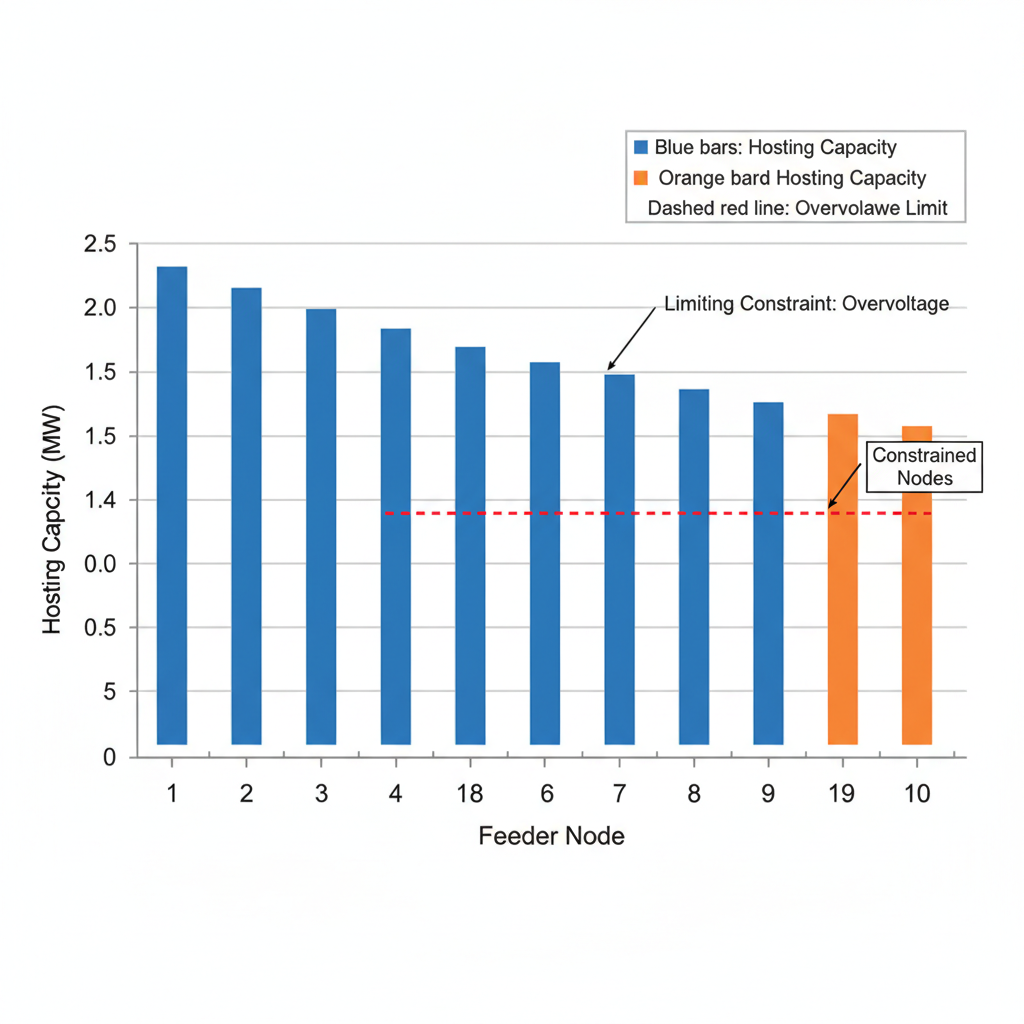
Figure 1. Hosting capacity by feeder node. The horizontal axis identifies the feeder node and the vertical axis is the maximum DER capacity in megawatts that can be accommodated before a limit is violated. The dashed line marks the binding constraint, here steady-state overvoltage; nodes whose capacity falls below it are constrained. The engineer should observe that hosting capacity is highly location-dependent (the electrically weakest nodes near the feeder end accept the least DER), so a single feeder-wide figure understates the capacity available at strong nodes and overstates it at weak ones.
Related Work
The analysis in this paper connects to several companion studies in this library. Readers concerned with the upstream and downstream engineering will find DER Integration Grid Impact Analysis develops a closely related aspect of the same problem, while DER Integration and Voltage Regulation extends the treatment into an adjacent domain. For the broader methodological context, Grid Modernization ROI Framework provides complementary depth.
Conclusion
Distribution planning for high DER penetration requires abandoning the peak-load-driven sizing paradigm in favor of methodology that recognizes the binding constraints have shifted to overvoltage during minimum-load maximum-generation conditions and to thermal limits during reverse power flow. The hosting-capacity analysis developed in this paper, particularly the time-series simulation approach, is the central tool for this transition because it evaluates feeder conditions across the full range of load and generation combinations rather than at a single peak-load snapshot, revealing the constraints that a deterministic peak analysis cannot. The central engineering conclusion is that non-wires alternatives (targeted DER, storage, and demand management deployed to defer conventional upgrades) become economically viable precisely because the new constraints are localized and time-bound, and can often be relieved more cheaply than by reconductoring. For the practicing planner, the operative takeaway is that the planning process must be reframed around time-series hosting-capacity analysis, since the questions that determine investment, where and when constraints bind, cannot be answered by the peak-load methods that served passive distribution systems.
References
[1] EPRI, Hosting Capacity Analysis for Distributed Energy Resources, EPRI Technical Report 3002004588, 2022.
[2] IEEE Standard 1547-2018, Standard for Interconnection and Interoperability of Distributed Energy Resources, IEEE, 2018.
[3] FERC Order 2023, Improvements to Generator Interconnection Procedures and Agreements, FERC, 2023.
[4] ANSI C84.1-2020, Electric Power Systems and Equipment: Voltage Ratings (60 Hz), ANSI, 2020.
[5] Rocky Mountain Institute, Non-Wires Alternatives: Case Studies from Leading Utilities, RMI, 2019.
[6] Lawrence Berkeley National Laboratory, Non-Wires Alternatives: Evaluating Their Potential for Distribution System Deferral, LBNL, 2020.
[7] NFPA 70, National Electrical Code, Articles 705, 706, 2023 edition, NFPA, 2023.
[8] NERC, Reliability Guideline: Distributed Energy Resources Connection Modeling and Reliability Considerations, NERC, 2022.